
Clean-burning on paper – but what happens in your living room?
Laboratory tests show excellent figures for clean-burning stoves. But at home, weather, draft and chimney conditions vary — so “lab = home” doesn’t hold.
Recently, various trade journals have published articles about the uncertain outlook for stove manufacturers and retailers. Most of us can agree this matters, not only for jobs, but also for sustainability and Norway’s access to firewood.
A claim we keep seeing and hearing concerns clean-burning stoves. Are they really as outstanding as described — or is that partly a myth?
An example from the real world
There are indications it may be the latter. What documentation actually exists, and under what conditions? The fact that these stoves are tested in a laboratory does not necessarily provide unequivocal evidence.
An illustration of this is the story of Pipe Eksperten in Halden, Norway. The company spent years developing a tool to reduce particulate emissions and eventually established a subsidiary, Clean Burn Tech AS. They tested their new product at Sintef, following current standards and using an already approved clean-burning stove. Ideally, one should not see any further improvement. So what happened?
The test results showed: up to 71 percent reduction in particulate emissions, up to 28 percent reduction in carbon monoxide (CO), and up to 72 percent reduction in organic gaseous compounds (OGC).
A natural question is how this is possible. An immediate answer might be that percentages can be misleading. I agree — but that argument does not hold here. We also have the actual measured values. The reality is that this new, Norwegian-made clean-burning stove has significant potential for improvement.
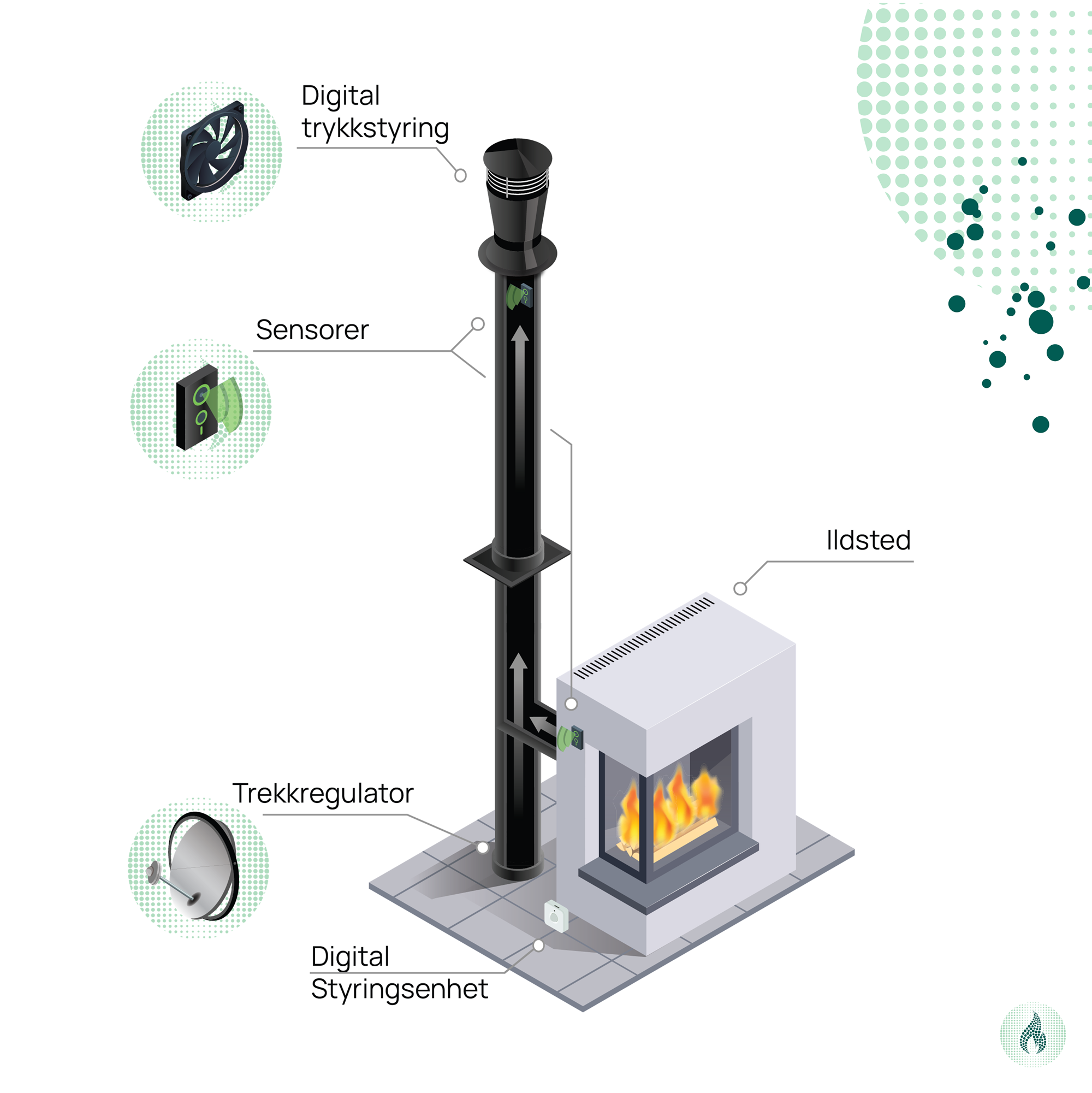
Small deviations, big effects
In our view, accredited laboratory testing takes place where the equipment can both set the relevant pressure (draft) to a value that matches the standard and keep that pressure stable during the test.
By contrast, when you buy the same stove and have it installed at home, atmospheric pressure applies. That is not stable; it varies with weather, wind and elevation above sea level. It is highly unlikely you will achieve the same pressure as in the lab test.
The likely consequence is that measurement results become worse than the lab figures because pressure (in pascals) appears to have a greater impact than previously assumed. Even small deviations from optimal pressure produce markedly negative effects. Moreover, Sintef’s test rig is optimally dimensioned for such testing — unlike typical conditions in private homes.
The industry needs to take everyday use seriously
Our experience is that the current standard is not particularly suitable as an approval criterion, and the industry should have a strong interest in updating it. Using a standard that works well in a lab, but differs significantly from real-world conditions in daily stove use, makes little sense.
The industry should therefore work together to tone down the glowing talk about “clean-burning” results and instead invest in further product development for everyday conditions.
Clean Burn Tech AS today has a largely developed and patented solution that performs just as well on old stoves as on new ones — which shows that there are opportunities.

Would you like more information about our system?

CLEAN BURN TECH AS Org. nr. 931 481 096
Visit us: B R A Veien 55, 1782 Halden
